
Professional-Academic Consultation on Social Gerontology in Maribor
On May 26, 2026, I participated in a professional-academic consultation in the field of social gerontology at the Alma Mater Europaea University in Maribor.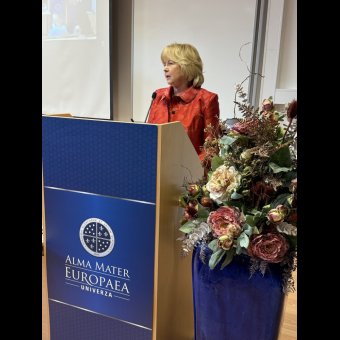
Gerontology - the science of aging includes BIOLOGICAL (physical health, functionality, mobility, endurance), PSYCHOLOGICAL (cognitive abilities, emotional well-being, personality, sense of identity) and SOCIAL (interpersonal relationships, inclusion, role in society, support from the environment) ASPECTS. These are interconnected and equally important carriers of this science. Bearing in mind that a significant number of elderly people are represented through the services of DOBRI DOM, especially in the Home Help program - delivery of hot meals, it was very interesting and useful to expand knowledge about the experiences of social gerontologists and academic experts in the aforementioned field. It is extremely important that all of us involved in the implementation of social services (regardless of workplace) for older people acquire basic knowledge in the field of gerontology and, through creative intergenerational activities, create opportunities for inclusion, dialogue and well-being so that our fellow citizens can be full, audible and active members of the community.
Below - Content downloaded: https://www.almamater.si/en/article/as-society-ages-who-will-care-for-the-elderly
Social gerontology highlights one of the key facts of Slovenia’s future: »We need people who know how to work with the elderly«.
The professional-academic consultation in the field of social gerontology at Alma Mater brought to the forefront one of the most important social issues of the future: How will we as a society care for the increasingly numerous older populations, and who will be the experts shaping this field?
Aging is not just a health issue
The consultation was opened with an introductory address by former Minister of Labour Janez Cigler Kralj, who pointed out that social gerontology represents one of the key professions of the future: »Due to demographic changes, Slovenia urgently needs additional professionally qualified staff in the fields of long-term care and social welfare. Conditions need to be created so that more of them will enter the field. By stopping or preventing entry, we will not be able to achieve this, « he emphasized regarding the issue of access for social gerontology graduates to the professional examination in the field of social welfare.
Prof. Emerita Dr. Jana Goriup was clear that social gerontology today represents one of the key fields in responding to the needs of a long-lived society and to demographic changes that are already strongly transforming Europe. In doing so, she highlighted the importance of connecting knowledge, research, and practice in shaping new professionals to work with older adults.
»Older people – that is us tomorrow«
An important message of the consultation was also emphasized by Aleš Kenda from the Ministry for a Solidary Future: »Older people – that is us tomorrow.« His words pointed out that aging is not a question of one individual generation, but of society as a whole.
Deputy Human Rights Ombudswoman Dr. Dijana Možina Zupanc pointed to numerous systemic problems in the care of older people – from staff shortages to unequal access to services and the social exclusion of older adults. »Human rights never grow old,« she emphasized, warning that without adequate staff, the long-term care system will not be able to provide quality support for older people.
Assist. Prof. Dr. Mateja Berčan also highlighted in her contribution the importance of palliative care in the home environment and stressed that quality support for older people is not possible without involving the family, mutual cooperation, and appropriate coordination between health and social services.
Words shape attitudes toward old age
Special attention was drawn to the research by Jerneja Lipič on language and society’s attitude toward older adults. The research showed that the expressions we use for older people significantly influence the experience of old age and society’s attitude toward aging.
»We see how much power words themselves have. Even today, the media use expressions that lead to an ageist view of old age and a gerontophobic fear of aging, « she warned.
Prof. Dr. Voyko Kavčič then presented the importance of geropsychology and cognitive neuroscience in understanding the aging process, while Senior Lecturer Dr. Suzana Oreški spoke about autonomy and mental health in old age and emphasized the importance of preserving the dignity of older adults even during periods of greater vulnerability.
A profession of the future that society still overlooks
One of the central topics of the consultation was also the issue of the position of social gerontologists in Slovenia. Representatives of the profession warned that, at a time of growing needs for long-term care, the state still limits the inclusion of professionals whom the system urgently needs.
»In the field of social welfare, we urgently need professional staff like you,« emphasized the Secretary General of the Social Chamber of Slovenia Suzi Kvas.
Graduate Jana Sever pointed out the hardship faced by young professionals: »Social gerontologists do not want privileges; we want to do the work we were educated for.«
Senior Lecturer Dr. Nataša Štandeker emphasized that the social gerontologist represents an important bridge between the individual, the family, and the long-term care system, and that this is a profession of the future that will become increasingly important in a long-lived society.
The society of the future will show how well it knows how to care for older people
The consultation also offered numerous examples of good practices and innovative approaches in working with older adults. M.A. Barbara Žgajner presented the example of the Maribor Home Assistance Center and emphasized that quality care is based above all on relationships: »Everything we do stands or falls on the relationship.«
In addition to those mentioned above, contributions were also presented by Jasmina Kristovič, M.A., Senior Lecturer Mirjana Ivanuša, M.A., Associate Prof. Dr. Jadranka Stričević, Assist. Prof. Dr. Barbara Grintal, Aleksander Onišak, Assist. Prof. Dr. Mihaela Kežman, Štefanija Zlobec, Assist. Prof. Dr. Marko Vidnjevič and Assist. Prof. Dr. Polonca Serrano, who highlighted the fields of mental health, dementia, ergonomic aging, creative approaches in working with older people, and the importance of intergenerational connection and active aging. Special attention was also devoted to raising public awareness about dementia, the quality of life of older adults, and the inclusion of older people in sports, social, and creative activities.
The event brought together experts, researchers, representatives of institutions, service providers, students, and graduates of social gerontology and opened key questions concerning a long-lived society, long-term care, and attitudes toward older adults. The discussions showed that population aging is no longer a question of the future, but one of the central social realities of the present time, which will significantly shape the quality of life of future generations.